Animal · Italy, Switzerland, France
Alpine ibex
Capra ibex — the name this animal has in the language scientists everywhere share.
The Alpine ibex is a sure-footed wild goat that lives on steep, rocky slopes high in the European Alps. Males grow huge, curved horns that can be longer than the animal itself is tall.
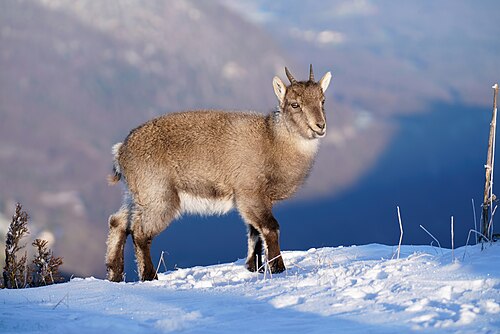
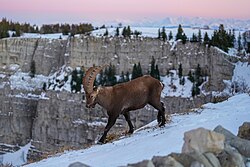
Picture credit: Giles Laurent (CC BY-SA 4.0) · Giles Laurent (CC BY-SA 4.0) · Wikimedia Commons
Where does the alpine ibex live?
Home: Steep rocky slopes high in the European Alps.
In the wild you find it in: Italy, Switzerland, France, Austria, Germany, Slovenia.
Conservation status from the IUCN: not in danger.
The short profile
Fully grown it measures up to 1.5 m long. It weighs about 90 kilograms. On the menu: plants.
The story behind it
An Alpine ibex can climb almost vertical rock faces and even the sheer walls of dams, using specially shaped hooves with a hard rim and a soft, grippy centre pad that acts like a natural climbing shoe. A male's ridged horns can grow to over a metre long and get a new ring each year, letting scientists estimate the animal's age just by counting them, much like tree rings. Ibex often lick minerals directly off rocky dam walls, a behaviour that has made them famous in viral photos. Hunted to near extinction in the 1800s, with only around 100 animals surviving in one protected Italian valley, careful reintroduction programmes have since restored Alpine ibex to mountains across the Alps.
Find it on the globe
Alpine ibex is there as a tiny animated figure that breathes and looks around. From far away the planet is only a blue ball; detail arrives as you zoom in, and this one appears once you are close enough. Open it on the globe.
It sits at its real coordinates, not near them — the same numbers listed in the facts above. Switch off the layer for this kind of place and it disappears again; the buttons for that are down the right-hand edge.
Questions children ask
How can ibex climb steep dam walls?
Ibex hooves have a hard outer rim for grip on tiny ledges and a soft, rubbery inner pad that grips smooth rock or concrete surfaces, letting them safely walk up almost vertical dam walls to lick mineral deposits.
How old can you tell an ibex is from its horns?
A male ibex grows a new ridge on its horns every year, so counting these rings, much like counting tree rings, lets scientists estimate its exact age quite accurately.
Were Alpine ibex ever nearly extinct?
Yes, overhunting reduced Alpine ibex to only around 100 animals in one protected valley in Italy by the early 1800s. Careful reintroduction efforts over the following two centuries have since restored them across the Alps.
Where these numbers come from
Every figure on this page was checked against public reference sources before publication. Where sources genuinely disagree, the text says so.
Last checked: