Animal · Switzerland, France, Italy
Alpine marmot
Marmota marmota — the name this animal has in the language scientists everywhere share.
The Alpine marmot is a large, burrowing rodent that lives in family colonies on high mountain meadows across the European Alps. Its sharp, high-pitched whistle warns the whole colony of danger.
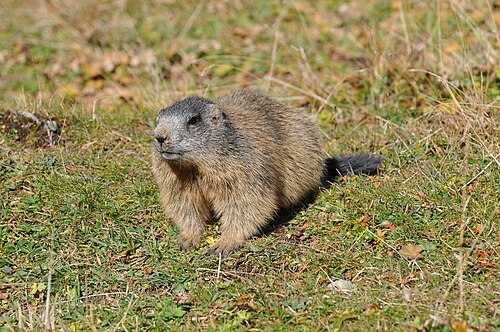
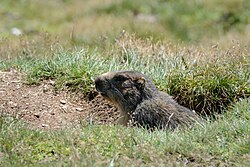
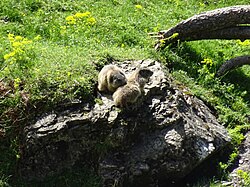
Picture credit: Böhringer Friedrich (CC BY-SA 3.0 at) · Uoaei1 (CC BY-SA 4.0) · Syrio (CC BY-SA 4.0) · Wikimedia Commons
Where does the alpine marmot live?
Home: High alpine meadows of the European mountains.
In the wild you find it in: Switzerland, France, Italy, Austria, Germany, Slovenia.
Conservation status from the IUCN: not in danger.
The short profile
Fully grown it measures up to 55 cm long, plus a 15 cm tail. It weighs about 5 kilograms. On the menu: plants.
The story behind it
Alpine marmots spend up to six months of the year in deep hibernation, sleeping in family groups inside burrows sealed with grass and dirt, sharing body heat to survive freezing mountain winters on almost no food at all. Before hibernating, they must nearly double their body weight by feasting on alpine grasses and flowers all summer long. A marmot on watch duty gives loud, sharp whistles to warn the colony of eagles or foxes, with different calls apparently signalling threats from the air versus the ground. Young marmots stay with their family for two to three years, helping raise younger siblings before starting colonies of their own. Thanks to strong protection, Alpine marmot populations remain healthy and are a common sight for hikers today.
Find it on the globe
Alpine marmot is there as a tiny animated figure that breathes and looks around. From far away the planet is only a blue ball; detail arrives as you zoom in, and this one appears once you are close enough. Open it on the globe.
It sits at its real coordinates, not near them — the same numbers listed in the facts above. Switch off the layer for this kind of place and it disappears again; the buttons for that are down the right-hand edge.
Questions children ask
Why do marmots whistle?
A marmot on lookout duty whistles sharply to warn the whole colony that a predator like an eagle or fox is approaching, giving family members time to dive into their burrows. Different whistle patterns may signal different types of danger.
How long do marmots hibernate?
Alpine marmots hibernate for up to six months each year, from around October to April, huddled together in family groups underground to conserve warmth and energy through the harsh alpine winter.
How much weight does a marmot gain before winter?
An Alpine marmot can nearly double its body weight over the summer by eating almost constantly, building up the fat reserves it needs to survive up to six months of hibernation without eating at all.
Where these numbers come from
Every figure on this page was checked against public reference sources before publication. Where sources genuinely disagree, the text says so.
Last checked: