Animal · United States, Canada
American bison
Bison bison — the name this animal has in the language scientists everywhere share.
The American bison is the largest land mammal in North America, once roaming the Great Plains in herds of tens of millions. Its huge shaggy head and shoulder hump make it instantly recognisable.
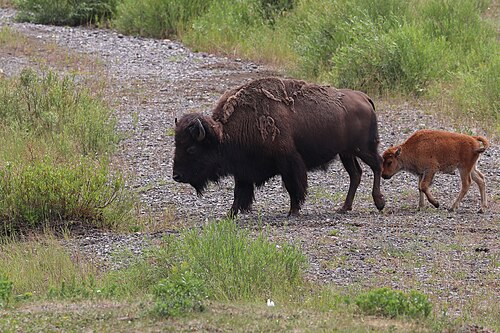
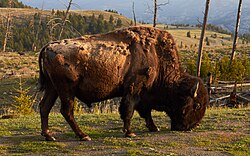
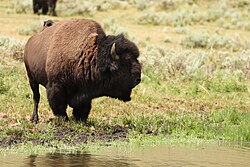
Picture credit: Lucas Golden (CC BY 4.0) · Frank Schulenburg (CC BY-SA 4.0) · Lucas Golden (CC BY 4.0) · Wikimedia Commons
Where does the american bison live?
Home: Grassy plains and prairies of North America.
In the wild you find it in: United States, Canada.
Conservation status from the IUCN: close to being at risk.
The short profile
Fully grown it measures up to 3.8 m long. It weighs about 900 kilograms. On the menu: plants.
The story behind it
In the early 1800s, an estimated 30 to 60 million bison roamed North America, but by the late 1800s, hunting had reduced them to only a few hundred animals, one of the most dramatic wildlife collapses ever recorded. Despite weighing nearly a tonne, a bison can run at up to 55 km/h and jump surprisingly high fences, faster than most horses over short distances. Its massive head works like a snowplough, swinging side to side to clear snow and reach grass underneath in winter. Thanks to dedicated conservation efforts starting in the early 20th century, bison numbers have recovered from near extinction to several hundred thousand today, though the species remains near threatened.
Find it on the globe
American bison is there as a tiny animated figure that breathes and looks around. From far away the planet is only a blue ball; detail arrives as you zoom in, and this one appears once you are close enough. Open it on the globe.
It sits at its real coordinates, not near them — the same numbers listed in the facts above. Switch off the layer for this kind of place and it disappears again; the buttons for that are down the right-hand edge.
Questions children ask
How many bison are left today?
Around 500,000 bison exist today across North America, mostly on ranches and in conservation herds, recovered from as few as a few hundred animals in the late 1800s thanks to dedicated protection efforts.
Can bison run fast despite being so big?
Yes, despite weighing close to a tonne, a bison can run at up to 55 km/h and can even jump fences over 1.8 metres high, making it far quicker and more agile than it looks.
What happened to the American bison?
Massive commercial hunting in the 1800s nearly wiped out bison, reducing tens of millions to just a few hundred animals within decades. Conservation programmes and protected herds later brought the species back from the edge of extinction.
Where these numbers come from
Every figure on this page was checked against public reference sources before publication. Where sources genuinely disagree, the text says so.
Last checked: