Animal · Iceland, Greenland, Norway
Arctic fox
Vulpes lagopus — the name this animal has in the language scientists everywhere share.
The Arctic fox is a small, hardy fox built to survive the freezing cold of the Arctic tundra. Its thick white winter coat turns brownish-grey in summer to match the changing landscape.
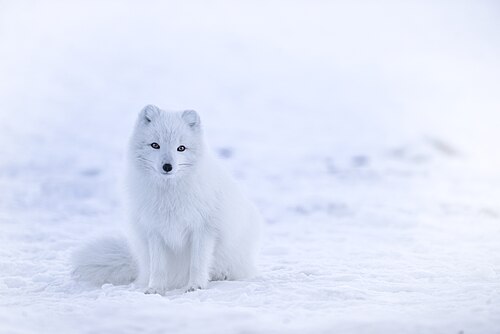
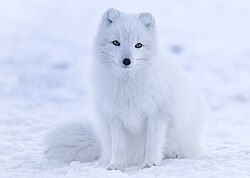
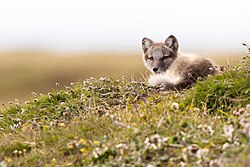
Picture credit: unsplash.com/@r3dmax (CC0) · unsplash.com/@r3dmax (CC0) · Alaska Region U.S. Fish & Wildlife Service (Public domain) · Wikimedia Commons
Where does the arctic fox live?
Home: Arctic tundra around the North Pole.
In the wild you find it in: Iceland, Greenland, Norway, Russia, Canada, United States, Sweden, Finland.
Conservation status from the IUCN: not in danger.
The short profile
Fully grown it measures up to 55 cm long, plus a 30 cm tail. It weighs about 4 kilograms. On the menu: both plants and meat.
The story behind it
The Arctic fox has the warmest fur of any mammal, so well insulated that it does not even start shivering until temperatures drop to around minus 70 degrees Celsius. Its small, rounded ears and short muzzle lose less heat than a red fox's, an adaptation for surviving the polar cold. Arctic foxes often follow polar bears across the ice, scavenging leftover scraps from seal kills. In lean years, some individuals travel astonishing distances across sea ice, with one fox once tracked walking over 3,500 km from Norway to Canada. Thanks to their toughness and wide range, Arctic fox numbers remain healthy overall.
Find it on the globe
Arctic fox is there as a tiny animated figure that breathes and looks around. From far away the planet is only a blue ball; detail arrives as you zoom in, and this one appears once you are close enough. Open it on the globe.
It sits at its real coordinates, not near them — the same numbers listed in the facts above. Switch off the layer for this kind of place and it disappears again; the buttons for that are down the right-hand edge.
Questions children ask
Why does the Arctic fox change colour?
An Arctic fox grows a thick white coat in winter to blend in with snow and a thinner brownish-grey coat in summer to match bare tundra rock and soil. This seasonal camouflage helps it hide from predators and sneak up on prey.
How cold can an Arctic fox survive?
An Arctic fox can withstand temperatures as low as about minus 70 degrees Celsius without shivering, thanks to its extremely thick, insulating fur. It also curls its bushy tail around its body and nose for extra warmth.
Do Arctic foxes follow polar bears?
Yes, Arctic foxes often trail polar bears across sea ice to scavenge leftover meat from seal kills, saving themselves the effort of hunting alone. This clever partnership helps foxes survive harsh Arctic winters.
Where these numbers come from
Every figure on this page was checked against public reference sources before publication. Where sources genuinely disagree, the text says so.
Last checked: