Animal · Mongolia, China, Kazakhstan
Bactrian camel
Camelus bactrianus — the name this animal has in the language scientists everywhere share.
The Bactrian camel is the two-humped camel of Central Asia, built to survive the extreme heat and freezing cold of the Gobi Desert. A small, critically threatened wild population still roams remote Mongolia and China.
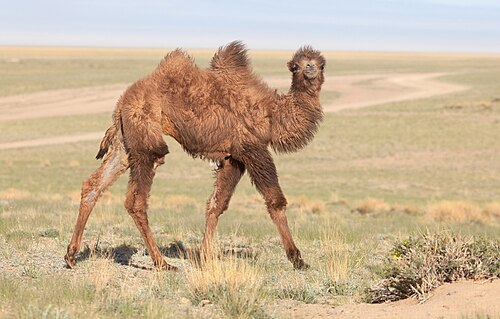
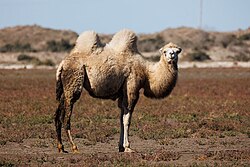
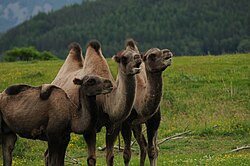
Picture credit: Alexandr frolov (CC BY-SA 4.0) · Михаил Голомысов (CC BY 4.0) · Aaronsneddon (CC BY-SA 3.0) · Wikimedia Commons
Where does the bactrian camel live?
Home: Cold deserts and steppes of Central Asia, especially the Gobi Desert.
In the wild you find it in: Mongolia, China, Kazakhstan.
Conservation status from the IUCN: endangered.
The short profile
Fully grown it measures up to 3.5 m long. It weighs about 650 kilograms. On the menu: plants.
The story behind it
A Bactrian camel's two humps store fat, not water, which its body can convert into energy and water when food is scarce during long desert crossings, sometimes causing the humps to flop over when depleted. It can survive incredible temperature swings, from over 40 degrees Celsius in summer to minus 40 in winter, thanks to a thick double coat that it sheds in messy clumps each spring. Its wide, padded feet spread out to avoid sinking into sand, while thick eyelashes and closable nostrils protect it from blinding desert sandstorms. The truly wild Bactrian camel, genetically distinct from domestic camels, now numbers only around a thousand animals in the Gobi Desert, making it critically threatened even though domesticated Bactrian camels remain common across Central Asia.
Find it on the globe
Bactrian camel is there as a tiny animated figure that breathes and looks around. From far away the planet is only a blue ball; detail arrives as you zoom in, and this one appears once you are close enough. Open it on the globe.
It sits at its real coordinates, not near them — the same numbers listed in the facts above. Switch off the layer for this kind of place and it disappears again; the buttons for that are down the right-hand edge.
Questions children ask
What is stored inside a camel's humps?
A Bactrian camel's humps store fat rather than water, which its body can break down into energy and even water when food is scarce on long journeys through the desert. Empty humps flop over rather than staying upright.
How is the wild Bactrian camel different from farm camels?
Wild Bactrian camels are a genetically distinct, critically threatened species living only in remote parts of the Gobi Desert, separate from the millions of domesticated two-humped camels used by people across Central Asia.
How does a camel survive extreme desert temperatures?
A Bactrian camel copes with both scorching summers and freezing winters thanks to a thick, shedding double coat, wide feet suited to sand, and a body built to go long periods without drinking water by using fat stores in its humps.
Where these numbers come from
Every figure on this page was checked against public reference sources before publication. Where sources genuinely disagree, the text says so.
Last checked: