Animal · Germany, France, Russia
Eurasian beaver
Castor fiber — the name this animal has in the language scientists everywhere share.
The Eurasian beaver is the largest rodent in Europe, famous for building dams and lodges out of branches, mud and stones. It shapes entire wetlands with its constant construction work.
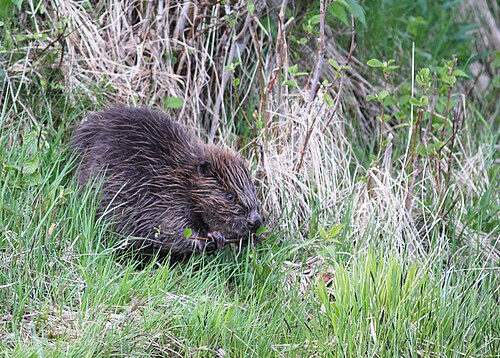
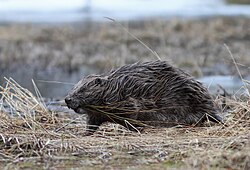
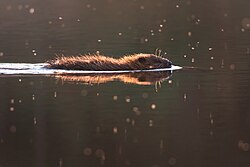
Picture credit: Bouke ten Cate (CC BY 4.0) · Bouke ten Cate (CC BY 4.0) · Ryzhkov Sergey (CC BY-SA 4.0) · Wikimedia Commons
Where does the eurasian beaver live?
Home: Rivers, lakes and wetlands across Europe and parts of Asia.
In the wild you find it in: Germany, France, Russia, Poland, Norway, Sweden, Finland, United Kingdom.
Conservation status from the IUCN: not in danger.
The short profile
Fully grown it measures up to 1 m long, plus a 35 cm flat tail. It weighs about 20 kilograms. On the menu: plants.
The story behind it
A beaver's front teeth never stop growing throughout its life, so it must constantly gnaw on wood to wear them down and keep them sharp, coated in tough orange enamel that is reinforced with iron. Beavers build dams to raise water levels around their lodge, creating a safe, deep pond entrance that predators like wolves cannot easily reach. Their flat, scaly tail acts as a rudder while swimming and a warning device, slapping the water loudly to alert the family of danger. By flooding land, beavers create wetlands that support countless other species, earning them the nickname 'ecosystem engineers'. Hunted to near extinction in past centuries for fur, beavers have made a strong comeback across Europe.
Find it on the globe
Eurasian beaver is there as a tiny animated figure that breathes and looks around. From far away the planet is only a blue ball; detail arrives as you zoom in, and this one appears once you are close enough. Open it on the globe.
It sits at its real coordinates, not near them — the same numbers listed in the facts above. Switch off the layer for this kind of place and it disappears again; the buttons for that are down the right-hand edge.
Questions children ask
Why do beavers build dams?
Beavers build dams to raise water levels around their lodge, creating a deep, safe pond that keeps the underwater entrance hidden and hard for predators like wolves to reach. Dams also help store food and control flooding.
Why do beavers gnaw on wood so much?
A beaver's front teeth grow continuously throughout its life, so it must gnaw constantly on wood to file them down and prevent them from growing too long. This gnawing also provides the branches it uses for building.
Are beavers good for the environment?
Yes, beavers are called ecosystem engineers because the wetlands their dams create provide habitat for fish, birds, frogs and insects, and can even help reduce flooding and improve water quality downstream.
Where these numbers come from
Every figure on this page was checked against public reference sources before publication. Where sources genuinely disagree, the text says so.
Last checked: