Animal · Switzerland, Austria, France
Chamois
Rupicapra rupicapra — the name this animal has in the language scientists everywhere share.
The chamois is a nimble goat-antelope that bounds across steep, rocky terrain in the mountains of Europe. Its short, hooked horns and distinctive dark face stripes make it easy to identify.
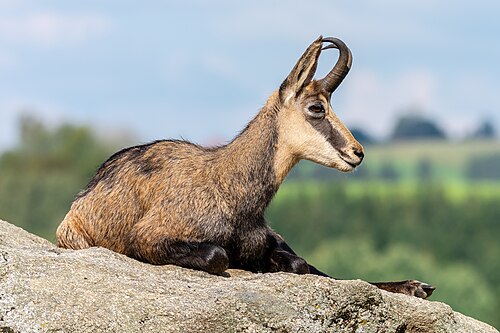
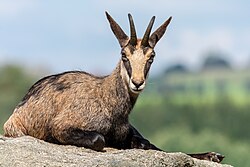
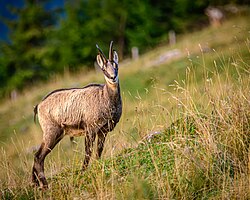
Picture credit: Isiwal (CC BY-SA 4.0) · Isiwal (CC BY-SA 4.0) · Stephan Sprinz (CC BY 4.0) · Wikimedia Commons
Where does the chamois live?
Home: Mountain forests and rocky slopes across Europe's mountain ranges.
In the wild you find it in: Switzerland, Austria, France, Italy, Germany, Slovenia, Slovakia, Romania.
Conservation status from the IUCN: not in danger.
The short profile
Fully grown it measures up to 1.3 m long. It weighs about 35 kilograms. On the menu: plants.
The story behind it
A chamois can leap up to 2 metres straight up and bound as far as 6 metres in a single jump across mountain terrain, using powerful hind legs and hooves with a rubbery outer edge for grip on wet rock and ice. It can also outrun most predators on steep slopes, reaching speeds of around 50 km/h even while climbing at difficult angles that would stop many animals entirely. In winter, chamois move to lower forested areas to shelter from harsh weather and find food buried under less snow, then return to high alpine meadows in summer. Their thick, water-resistant winter coat changes to a lighter, reddish-brown summer coat. Legal protection and controlled hunting have kept chamois populations stable across the mountains of Europe.
Find it on the globe
Chamois is there as a tiny animated figure that breathes and looks around. From far away the planet is only a blue ball; detail arrives as you zoom in, and this one appears once you are close enough. Open it on the globe.
It sits at its real coordinates, not near them — the same numbers listed in the facts above. Switch off the layer for this kind of place and it disappears again; the buttons for that are down the right-hand edge.
Questions children ask
How fast can a chamois run on steep slopes?
A chamois can reach speeds of around 50 km/h even on steep, rocky mountain terrain, thanks to powerful legs and grippy, rubber-edged hooves. This speed helps it easily outrun most predators like wolves and lynx.
Why does a chamois move between the mountains and forests?
Chamois move down to sheltered forested slopes in winter to escape harsh weather and find food under thinner snow, then return to open high alpine meadows in summer where fresh grass and herbs grow.
How can you tell a chamois from a goat?
A chamois has short, backward-curving hooked horns rather than long, sweeping ones, along with a distinctive dark stripe running through its eyes on a paler face. It is also generally slimmer and built for extreme agility.
Where these numbers come from
Every figure on this page was checked against public reference sources before publication. Where sources genuinely disagree, the text says so.
Last checked: