Animal · Germany, United Kingdom, France
Common pipistrelle bat
Pipistrellus pipistrellus — the name this animal has in the language scientists everywhere share.
The common pipistrelle is one of the smallest and most widespread bats in Europe, weighing about as much as a two-euro coin. It hunts flying insects at dusk using sound rather than sight.
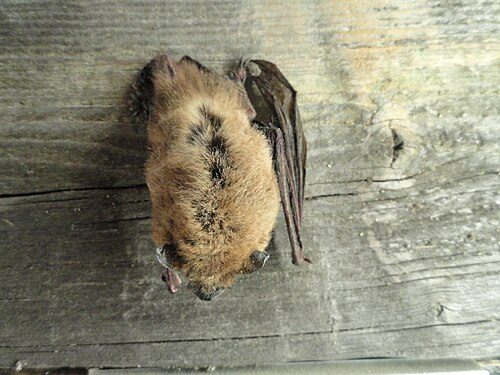
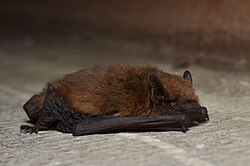
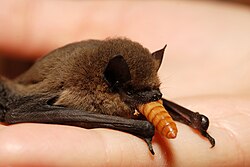
Picture credit: Daderot (CC0) · Gilles San Martin (CC BY-SA 2.0) · Gilles San Martin (CC BY-SA 2.0) · Wikimedia Commons
Where does the common pipistrelle bat live?
Home: Towns, woodlands and farmland across Europe.
In the wild you find it in: Germany, United Kingdom, France, Italy, Spain, Netherlands, Poland, Ireland.
Conservation status from the IUCN: not in danger.
The short profile
Fully grown it measures body about 4–5 cm long, wingspan up to 23 cm. It weighs about 0 005 kilograms. On the menu: insects.
The story behind it
A single common pipistrelle can eat around 3,000 tiny insects like midges and mosquitoes in just one night, making it an important natural pest controller. It finds prey using echolocation, sending out high-pitched clicks too high for human ears and listening to the echoes bouncing back to build a detailed sound picture of its surroundings in total darkness. Despite being so tiny, pipistrelles can live for over 15 years, a remarkably long lifespan for such a small mammal. They roost in tree holes, roof spaces and even narrow wall cracks, sometimes in colonies of hundreds. Bat populations declined in the 20th century due to pesticide use and lost roosts, but protection laws now help many colonies recover.
Find it on the globe
Common pipistrelle bat is there as a tiny animated figure that breathes and looks around. From far away the planet is only a blue ball; detail arrives as you zoom in, and this one appears once you are close enough. Open it on the globe.
It sits at its real coordinates, not near them — the same numbers listed in the facts above. Switch off the layer for this kind of place and it disappears again; the buttons for that are down the right-hand edge.
Questions children ask
How do bats find insects in the dark?
Bats use echolocation, sending out high-pitched clicks and listening to the echoes that bounce back off objects and prey. This lets them build a detailed picture of their surroundings and catch tiny flying insects even in total darkness.
How many insects can one bat eat in a night?
A single common pipistrelle bat can eat around 3,000 small insects like midges and mosquitoes in just one night, making bats extremely helpful for controlling insect pests naturally.
Are bats blind?
No, bats are not blind; the common pipistrelle can see reasonably well, but it relies mainly on echolocation to hunt in darkness, since sound works better than eyesight for catching fast, tiny insects at night.
Where these numbers come from
Every figure on this page was checked against public reference sources before publication. Where sources genuinely disagree, the text says so.
Last checked: