Animal · Australia, Somalia, Sudan
Dromedary
Camelus dromedarius — the name this animal has in the language scientists everywhere share.
The dromedary, or one-humped camel, is a desert animal so long domesticated that it no longer exists in its original wild form. Curiously, its largest truly wild-living herds today roam free in the Australian outback.
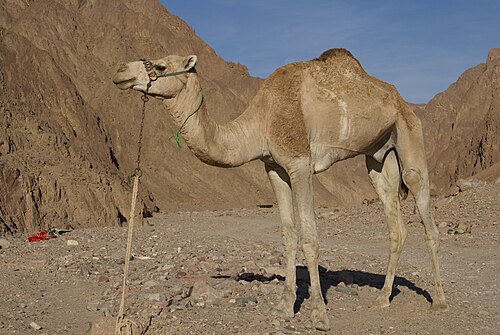
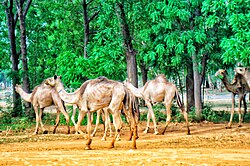
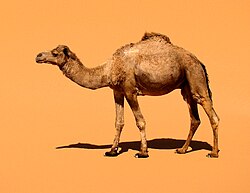
Picture credit: Florian Prischl (CC BY-SA 3.0) · Kitian06 (CC BY-SA 4.0) · Bjørn Christian Tørrissen (CC BY-SA 3.0) · Wikimedia Commons
Where does the dromedary live?
Home: Hot deserts of North Africa, the Middle East, and feral in the Australian outback.
In the wild you find it in: Australia, Somalia, Sudan, Ethiopia, Mauritania, Chad, Niger, Saudi Arabia.
The short profile
Fully grown it measures up to 3.5 m long. It weighs about 500 kilograms. On the menu: plants.
The story behind it
Dromedaries were brought to Australia in the 1800s to help explorers and settlers cross the vast, dry interior, and when trucks and trains later replaced them, many were released and now over a hundred thousand roam wild there today, the largest free-ranging camel population on Earth. A dromedary can drink up to 100 litres of water in just a few minutes and go without drinking again for over a week, thanks to red blood cells shaped like ovals rather than circles, which keep blood flowing even when the animal is very dehydrated. Thick fur on top of its body reflects sunlight, while thinner fur elsewhere lets heat escape at night. Domesticated dromedaries remain vital for transport and milk across deserts from the Sahara to Arabia.
Find it on the globe
Dromedary is there as a tiny animated figure that breathes and looks around. From far away the planet is only a blue ball; detail arrives as you zoom in, and this one appears once you are close enough. Open it on the globe.
It sits at its real coordinates, not near them — the same numbers listed in the facts above. Switch off the layer for this kind of place and it disappears again; the buttons for that are down the right-hand edge.
Questions children ask
Why are there wild camels in Australia?
Dromedaries were imported to Australia in the 1800s to help cross its dry interior, and when motor vehicles made them unnecessary, many were released into the wild, where they now form the world's largest free-roaming camel population.
How does a camel go so long without water?
A camel's oval-shaped red blood cells keep blood flowing smoothly even when it is very dehydrated, and its body is extremely efficient at conserving water, letting it survive over a week without drinking in hot desert conditions.
How many humps does a dromedary have?
A dromedary has just one hump, unlike the Bactrian camel of Central Asia, which has two. Its single hump stores fat that the camel's body uses for energy during long journeys with little food.
Where these numbers come from
Every figure on this page was checked against public reference sources before publication. Where sources genuinely disagree, the text says so.
Last checked: