Animal · United Kingdom, Germany, France
Eurasian otter
Lutra lutra — the name this animal has in the language scientists everywhere share.
The Eurasian otter is a sleek, playful swimmer found in rivers, lakes and coastlines across Europe and Asia. Its dense, waterproof fur keeps it warm even in icy water.
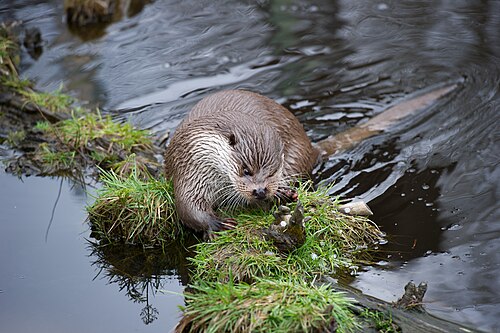
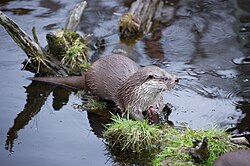
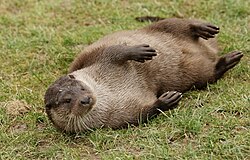
Picture credit: Alexander Leisser (CC BY-SA 4.0) · Alexander Leisser (CC BY-SA 4.0) · Peter Trimming (CC BY 2.0) · Wikimedia Commons
Where does the eurasian otter live?
Home: Rivers, lakes and coastlines across Europe and Asia.
In the wild you find it in: United Kingdom, Germany, France, Spain, Russia, Norway, Sweden, India.
Conservation status from the IUCN: close to being at risk.
The short profile
Fully grown it measures up to 90 cm long, plus a 45 cm tail. It weighs about 9 kilograms. On the menu: meat.
The story behind it
An otter's fur is so dense it can trap air close to the skin, keeping the animal warm and dry even during long swims in freezing rivers; a single square centimetre can hold up to 50,000 hairs, far more than a human head. Otters use their sensitive, long whiskers to detect the tiny movements of fish in murky or dark water, letting them hunt effectively even when they cannot see well. They are also known to be playful, sliding down muddy or snowy banks apparently just for fun. Once nearly wiped out across much of Europe by water pollution and hunting, otters have slowly returned to many rivers thanks to cleaner water, though the species remains near threatened.
Find it on the globe
Eurasian otter is there as a tiny animated figure that breathes and looks around. From far away the planet is only a blue ball; detail arrives as you zoom in, and this one appears once you are close enough. Open it on the globe.
It sits at its real coordinates, not near them — the same numbers listed in the facts above. Switch off the layer for this kind of place and it disappears again; the buttons for that are down the right-hand edge.
Questions children ask
How do otters stay warm in cold water?
Otters have extremely dense, waterproof fur that traps a layer of air close to their skin, keeping them insulated and dry even in icy rivers. They also groom constantly to keep this fur in top condition.
Why did otters disappear from some rivers?
Otters vanished from many European rivers in the 20th century mainly due to water pollution from pesticides and industry, along with habitat loss and hunting. Cleaner water in recent decades has helped many populations slowly return.
Do otters play?
Yes, otters are known for playful behaviour like sliding down muddy or snowy slopes, wrestling with siblings, and juggling small stones, which may also help young otters practise hunting skills.
Where these numbers come from
Every figure on this page was checked against public reference sources before publication. Where sources genuinely disagree, the text says so.
Last checked: