Animal · South Africa, United States, Australia
Great white shark
Carcharodon carcharias — the name this animal has in the language scientists everywhere share.
The great white shark is the largest predatory fish in the ocean, feared and misunderstood in equal measure. It patrols coastal and open waters across most of the world's oceans.
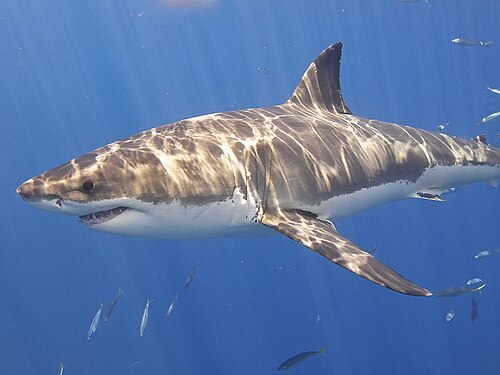
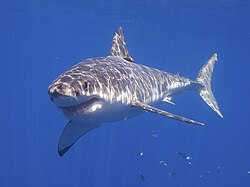
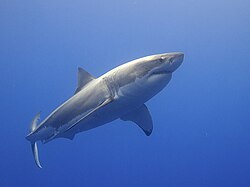
Picture credit: Elias Levy (CC BY 2.0) · Elias Levy (CC BY 2.0) · Elias Levy (CC BY 2.0) · Wikimedia Commons
Where does the great white shark live?
Home: Coastal and offshore waters of most oceans.
In the wild you find it in: South Africa, United States, Australia, Mexico, Japan.
Conservation status from the IUCN: vulnerable.
The short profile
Fully grown it measures 4–5 m long (up to 6 m). It weighs about 1 100 kilograms. On the menu: meat.
The story behind it
Great white sharks can detect a single drop of blood diluted in a huge volume of water and sense the faint electrical signals given off by a hiding fish's muscles, using special organs on their snout called the ampullae of Lorenzini. They are powerful hunters of seals, sea lions and fish, sometimes launching entirely out of the water in a spectacular attack called breaching. Despite their fearsome reputation from films, great whites rarely target humans; most bites are thought to be cases of mistaken identity, and far more sharks are killed by people than the reverse. They can swim across entire oceans, with tagged individuals recorded travelling thousands of kilometres. Overfishing and the shark fin trade have caused serious declines, leaving the species vulnerable.
Find it on the globe
Great white shark is there as a tiny animated figure that breathes and looks around. From far away the planet is only a blue ball; detail arrives as you zoom in, and this one appears once you are close enough. Open it on the globe.
It sits at its real coordinates, not near them — the same numbers listed in the facts above. Switch off the layer for this kind of place and it disappears again; the buttons for that are down the right-hand edge.
Questions children ask
Do great white sharks attack humans on purpose?
Rarely. Most shark bites on humans are thought to be cases of mistaken identity, where a shark investigates an unfamiliar shape, such as a surfer on a board, before quickly letting go once it realises it is not natural prey.
How do great white sharks find prey?
Great white sharks have an extraordinary sense of smell and can also detect the faint electrical signals produced by a hiding animal's muscles, using special sensors on their snout called the ampullae of Lorenzini.
Why are great white sharks vulnerable?
Great white sharks are vulnerable mainly because of overfishing, accidental capture in fishing nets, and the shark fin trade. They also reproduce slowly, having few pups, which makes it hard for populations to recover quickly.
Where these numbers come from
Every figure on this page was checked against public reference sources before publication. Where sources genuinely disagree, the text says so.
Last checked: