Animal · Germany, France, United States
Western honey bee
Apis mellifera — the name this animal has in the language scientists everywhere share.
The western honey bee lives in highly organised colonies of tens of thousands of workers and is one of the most important pollinators on Earth. It is now kept and studied worldwide.
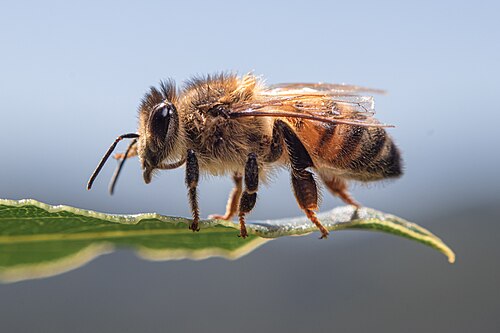
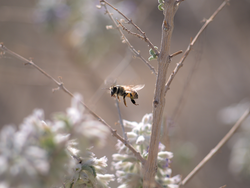
Picture credit: Andrea Fabiani Ph (CC BY-SA 4.0) · Missvain (CC BY 4.0) · ZombiUwU (CC BY-SA 4.0) · Wikimedia Commons
Where does the western honey bee live?
Home: Meadows, farmland and forests across the world.
In the wild you find it in: Germany, France, United States, China, Argentina.
The short profile
Fully grown it measures About 12–15 mm long. It weighs about 0 kilograms. On the menu: plants.
The story behind it
A honey bee colony functions almost like one giant organism, with a single queen laying up to 2,000 eggs a day, thousands of female worker bees doing all the colony's jobs, and a small number of male drones whose only role is to mate with a new queen. Worker bees communicate the location of good flowers to each other using a 'waggle dance', a series of movements that tells other bees the direction and distance to fly, one of the most complex forms of communication known outside humans. A single bee visits hundreds of flowers a day and, in doing so, pollinates roughly a third of the crops people eat worldwide, from apples to almonds. To make just one kilogram of honey, bees must visit around two million flowers. Bee populations face serious pressure from pesticides, disease and habitat loss, making their conservation status a growing concern.
Find it on the globe
Western honey bee is there as a tiny animated figure that breathes and looks around. From far away the planet is only a blue ball; detail arrives as you zoom in, and this one appears once you are close enough. Open it on the globe.
It sits at its real coordinates, not near them — the same numbers listed in the facts above. Switch off the layer for this kind of place and it disappears again; the buttons for that are down the right-hand edge.
Questions children ask
How do bees tell each other where flowers are?
Honey bees perform a 'waggle dance' inside the hive, moving in a figure-eight pattern that tells other bees the exact direction and distance to fly to reach good flowers, based on the angle of the dance relative to the sun.
Why are honey bees so important?
Honey bees pollinate roughly a third of the food crops people eat, carrying pollen from flower to flower as they collect nectar. Without enough bees, growing many fruits, vegetables and nuts would become much harder.
How much honey does a colony make?
A healthy honey bee colony can produce far more honey than it needs to survive winter, sometimes over 25 kg a year, which is why beekeepers can harvest the extra without harming the colony.
Where these numbers come from
Every figure on this page was checked against public reference sources before publication. Where sources genuinely disagree, the text says so.
Last checked: