Animal · Canada, Greenland, Norway
Narwhal
Monodon monoceros — the name this animal has in the language scientists everywhere share.
The narwhal is famous for the male's long, spiralled tusk, which can grow up to 3 metres, earning it the nickname 'unicorn of the sea'. It lives year-round in the icy Arctic Ocean.
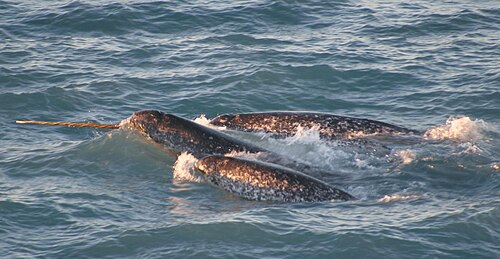


Picture credit: Dr. Kristin Laidre, Polar Science Center, UW NOAA/OAR/OER (Public domain) · Dr. Kristin Laidre, Polar Science Center, UW NOAA/OAR/OER (Public domain) · Gazprom neft (CC BY-SA 4.0) · Wikimedia Commons
Where does the narwhal live?
Home: The icy waters of the Arctic Ocean.
In the wild you find it in: Canada, Greenland, Norway, Russia.
Conservation status from the IUCN: not in danger.
The short profile
Fully grown it measures 3–5.5 m long, not including the tusk. It weighs about 1 200 kilograms. On the menu: meat.
The story behind it
A narwhal's tusk is actually an overgrown left canine tooth that spirals outward through the upper lip, and scientists have discovered it is packed with millions of nerve endings, suggesting it can sense changes in water, such as temperature and salt levels. Males mostly use it in gentle sparring matches with other males, not for hunting or fighting predators. Narwhals dive to extraordinary depths of over 1,500 metres to hunt fish and squid on the dark ocean floor, and spend much of the year swimming among sea ice, using leads, or cracks, in the ice to breathe. They live in tight groups and communicate with clicks, whistles and knocks. Narwhals depend heavily on sea ice, so their future is closely tied to how quickly the Arctic continues to warm.
Find it on the globe
Narwhal is there as a tiny animated figure that breathes and looks around. From far away the planet is only a blue ball; detail arrives as you zoom in, and this one appears once you are close enough. Open it on the globe.
It sits at its real coordinates, not near them — the same numbers listed in the facts above. Switch off the layer for this kind of place and it disappears again; the buttons for that are down the right-hand edge.
Questions children ask
What is a narwhal's tusk actually for?
A narwhal's tusk is an overgrown tooth packed with nerve endings that may help it sense the water around it. Males mostly use their tusks in gentle sparring with other males rather than for hunting or fighting.
How deep can narwhals dive?
Narwhals can dive more than 1,500 metres deep, among the deepest dives of any marine mammal, to hunt fish and squid near the dark ocean floor. Each dive can last around 25 minutes.
Do only male narwhals have tusks?
Almost only males grow a visible tusk, though very rarely a female grows one too, and some males even develop two. The tusk keeps growing throughout a male narwhal's life, sometimes reaching 3 metres long.
Where these numbers come from
Every figure on this page was checked against public reference sources before publication. Where sources genuinely disagree, the text says so.
Last checked: