Animal · India, Sri Lanka, Nepal
Indian peafowl
Pavo cristatus — the name this animal has in the language scientists everywhere share.
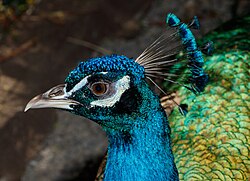
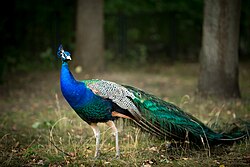
The peacock, or Indian peafowl, is famous for the male's dazzling train of iridescent blue-green feathers. It lives in forests, farmland and villages across India and Sri Lanka.
Picture credit: MichaelMaggs (CC BY-SA 3.0) · H. Zell (CC BY-SA 3.0) · BlessPL (CC BY-SA 4.0) · Wikimedia Commons
Where does the indian peafowl live?
Home: Forests and farmland across India and Sri Lanka.
In the wild you find it in: India, Sri Lanka, Nepal.
Conservation status from the IUCN: not in danger.
The short profile
Fully grown it measures Males up to 2.3 m long including train. It weighs about 5 kilograms. On the menu: both plants and meat.
The story behind it
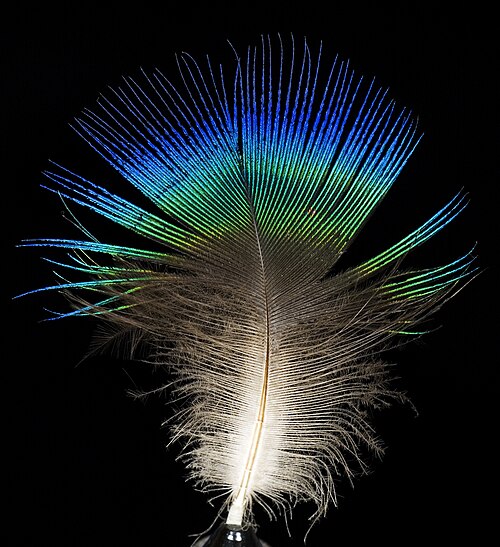
What looks like a peacock's tail is actually a set of long upper tail-covert feathers, not the tail itself, and it can be spread into a huge fan covered in eye-like spots. Males shake and rattle this train during a courtship dance to attract females, called peahens, who choose their mate partly based on how impressive and symmetrical the display looks. The shimmering colours are not from pigment at all; microscopic structures in the feathers bend light to create the iridescent blues and greens, similar to how a soap bubble shows colour. Peafowl are omnivores, eating seeds, insects, small reptiles and even snakes. They are considered sacred in parts of India and are protected as the country's national bird.
Find it on the globe
Indian peafowl is there as a tiny animated figure that breathes and looks around. From far away the planet is only a blue ball; detail arrives as you zoom in, and this one appears once you are close enough. Open it on the globe.
It sits at its real coordinates, not near them — the same numbers listed in the facts above. Switch off the layer for this kind of place and it disappears again; the buttons for that are down the right-hand edge.
Questions children ask
Why do peacocks have such colourful tails?
Male peacocks display their long, iridescent train to attract females during courtship. The bigger and more symmetrical the fan of eyespots, the more likely a female is to choose that male as her mate.
Are peacock feathers actually blue and green?
Not exactly. Peacock feathers contain almost no blue or green pigment; instead, tiny structures inside each feather bend light to reflect those colours, the same trick that makes soap bubbles and butterfly wings shimmer.
Do female peafowl have colourful tails too?
No, female peafowl, called peahens, have mostly brown and grey feathers and no long train. Their duller colours help them stay hidden while nesting, while the male's bright display is purely for attracting a mate.
Where these numbers come from
Every figure on this page was checked against public reference sources before publication. Where sources genuinely disagree, the text says so.
Last checked: