Animal · Australia
Quokka
Setonix brachyurus — the name this animal has in the language scientists everywhere share.
The quokka is a small, cat-sized marsupial famous for its friendly, smiling face, found mainly on Rottnest Island off the coast of Western Australia. It hops much like a tiny kangaroo.
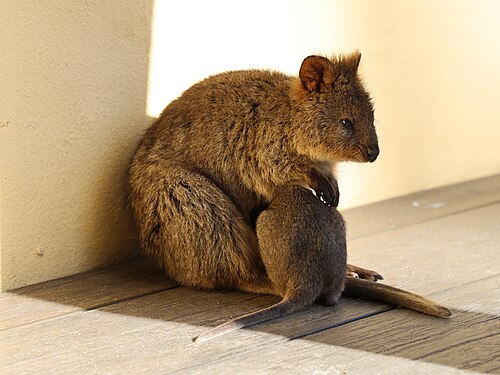
Picture credit: JamesHenstridge (CC BY-SA 4.0) · Wikimedia Commons
Where does the quokka live?
Home: Rottnest Island and small pockets of southwestern Australia.
In the wild you find it in: Australia.
Conservation status from the IUCN: vulnerable.
The short profile
Fully grown it measures up to 55 cm long, plus a 30 cm tail. It weighs about 4 kilograms. On the menu: plants.
The story behind it
The quokka's mouth naturally curves upward, which combined with its curiosity around visitors has made it famous worldwide as the animal that always seems to be smiling for photos. Quokkas are mostly active at night and can climb small trees and shrubs to reach leaves, unusual behaviour for a kangaroo relative. When a mother quokka is chased by a predator, she may drop her joey from her pouch as a distraction, giving the joey a slim chance to escape while she flees. Introduced predators like foxes and cats, along with habitat loss on the mainland, have made quokkas vulnerable, though the Rottnest Island population, free of these predators, remains much safer.
Find it on the globe
Quokka is there as a tiny animated figure that breathes and looks around. From far away the planet is only a blue ball; detail arrives as you zoom in, and this one appears once you are close enough. Open it on the globe.
It sits at its real coordinates, not near them — the same numbers listed in the facts above. Switch off the layer for this kind of place and it disappears again; the buttons for that are down the right-hand edge.
Questions children ask
Why does the quokka always look like it is smiling?
A quokka's mouth is naturally shaped in a way that curves upward, making it look like a permanent smile, especially in photos with curious tourists. This has earned it the nickname 'world's happiest animal', though it is simply its natural face shape.
Is it safe to take a selfie with a quokka?
Quokkas are naturally curious and approach people on Rottnest Island, but touching or feeding them is discouraged and against local rules, since human food can harm them. Visitors should keep a respectful distance for photos.
Are quokkas endangered?
Quokkas are classed as vulnerable, mainly on the Australian mainland where introduced foxes and cats prey on them and habitat has shrunk. The population on predator-free Rottnest Island remains much larger and more stable.
Where these numbers come from
Every figure on this page was checked against public reference sources before publication. Where sources genuinely disagree, the text says so.
Last checked: