Animal · Costa Rica, Brazil, Peru
Scarlet macaw
Ara macao — the name this animal has in the language scientists everywhere share.
The scarlet macaw is one of the largest and most colourful parrots, with brilliant red, yellow and blue feathers. It flies in noisy flocks through the rainforest canopy of Central and South America.
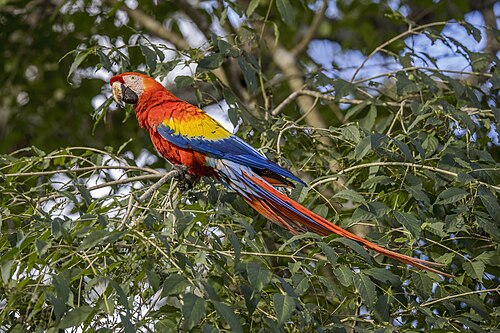
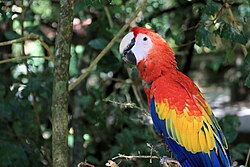
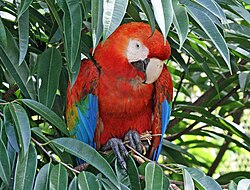
Picture credit: Charles J. Sharp (CC BY-SA 4.0) · ImagePerson (CC BY 4.0) · Dick Daniels (CC BY-SA 3.0) · Wikimedia Commons
Where does the scarlet macaw live?
Home: Tropical rainforests of Central and South America.
In the wild you find it in: Costa Rica, Brazil, Peru, Honduras, Mexico.
Conservation status from the IUCN: not in danger.
The short profile
Fully grown it measures 80–90 cm long, including a long tail. It weighs about 1 kilograms. On the menu: plants.
The story behind it
Scarlet macaws mate for life and are often seen flying in pairs, calling loudly to stay in contact through the dense canopy. Their powerful, hooked beak can crack open even the hardest rainforest nuts and seeds, and they also eat unripe fruit that would poison many other animals. To handle the toxins, macaws in some areas visit exposed riverbank cliffs called clay licks, where dozens of birds gather to eat mineral-rich clay that helps neutralise the poisons and settle their stomachs. Chicks stay with their parents for up to a year, learning to fly and find food. Though still widespread, scarlet macaws have disappeared from parts of their range due to logging and capture for the pet trade.
Find it on the globe
Scarlet macaw is there as a tiny animated figure that breathes and looks around. From far away the planet is only a blue ball; detail arrives as you zoom in, and this one appears once you are close enough. Open it on the globe.
It sits at its real coordinates, not near them — the same numbers listed in the facts above. Switch off the layer for this kind of place and it disappears again; the buttons for that are down the right-hand edge.
Questions children ask
Do scarlet macaws mate for life?
Yes, scarlet macaws form strong pair bonds and usually stay with the same partner for life. Pairs fly, feed and preen each other together, and can often be spotted flying side by side through the forest.
Why do macaws eat clay?
Macaws visit riverbank clay licks to eat mineral-rich clay, which is thought to help neutralise toxins found in the unripe fruit and seeds they eat. Dozens of macaws sometimes gather at one clay lick at the same time.
How long do scarlet macaws live?
Scarlet macaws can live 40 to 50 years in the wild, and even longer in captivity. Their long lifespan means a young macaw can stay with the same mate and flock for most of its life.
Where these numbers come from
Every figure on this page was checked against public reference sources before publication. Where sources genuinely disagree, the text says so.
Last checked: