Animal · Costa Rica, Panama, Nicaragua
Brown-throated sloth
Bradypus variegatus — the name this animal has in the language scientists everywhere share.
The brown-throated sloth is one of the slowest-moving mammals on Earth, spending nearly its whole life hanging upside down in rainforest trees. It moves so little that algae grows in its fur.
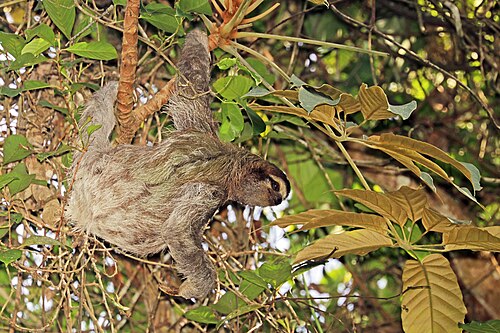
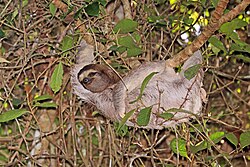
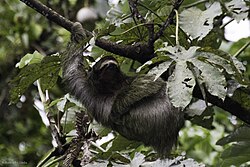
Picture credit: Charles J. Sharp (CC BY-SA 4.0) · Charles J. Sharp (CC BY-SA 4.0) · Ken-ichi Ueda (CC BY 4.0) · Wikimedia Commons
Where does the brown-throated sloth live?
Home: Tropical rainforests of Central and South America.
In the wild you find it in: Costa Rica, Panama, Nicaragua, Honduras, Colombia, Venezuela, Ecuador, Brazil.
Conservation status from the IUCN: not in danger.
The short profile
Fully grown it measures up to 60 cm long. It weighs about 4 kilograms. On the menu: plants.
The story behind it
A sloth moves so slowly, at about 250 metres per hour at most, that green algae grow in the grooves of its fur, giving it a greenish tint that helps camouflage it among leaves. Its extremely slow metabolism means it can take up to a month to fully digest a single meal of leaves. Sloths only come down from the trees roughly once a week to go to the toilet on the ground, a risky trip that makes them vulnerable to predators like jaguars. Despite moving slowly, sloths are excellent swimmers and can hold their breath for up to 40 minutes underwater. Their slow lifestyle actually helps them survive, since it uses very little energy and keeps them quiet.
Find it on the globe
Brown-throated sloth is there as a tiny animated figure that breathes and looks around. From far away the planet is only a blue ball; detail arrives as you zoom in, and this one appears once you are close enough. Open it on the globe.
It sits at its real coordinates, not near them — the same numbers listed in the facts above. Switch off the layer for this kind of place and it disappears again; the buttons for that are down the right-hand edge.
Questions children ask
Why does a sloth have green fur sometimes?
A sloth moves so little that algae grow directly in the grooves of its fur, giving it a greenish tint that camouflages it among rainforest leaves. This algae may also provide a tiny bit of extra nutrition.
How slow is a sloth really?
A sloth travels at roughly 250 metres per hour on the ground, making it one of the slowest mammals alive. Its sluggish pace saves huge amounts of energy, which matters because its leafy diet provides so little of it.
Can sloths swim?
Yes, surprisingly, sloths are strong swimmers and can move about three times faster in water than on land, using a paddling stroke. They can even hold their breath underwater for up to 40 minutes.
Where these numbers come from
Every figure on this page was checked against public reference sources before publication. Where sources genuinely disagree, the text says so.
Last checked: