Animal · United Kingdom, Germany, Netherlands
Mute swan
Cygnus olor — the name this animal has in the language scientists everywhere share.
The mute swan is one of the heaviest flying birds in the world, gliding gracefully across lakes and rivers with its curved neck and orange bill. It lives across Europe and temperate Asia.
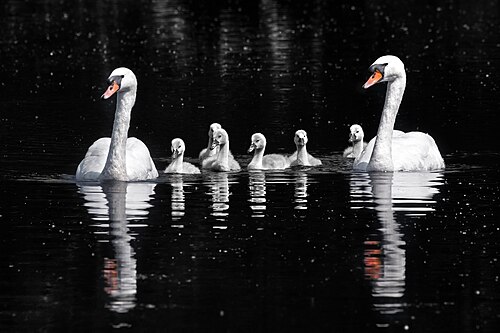
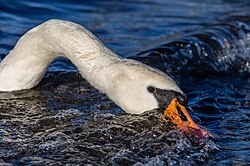
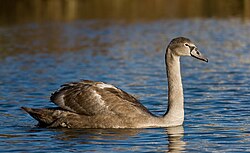
Picture credit: Charles J. Sharp (CC BY-SA 4.0) · Michal Klajban (CC BY-SA 4.0) · Thermos (CC BY-SA 3.0) · Wikimedia Commons
Where does the mute swan live?
Home: Lakes, rivers and wetlands across Europe and temperate Asia.
In the wild you find it in: United Kingdom, Germany, Netherlands, Poland, France.
Conservation status from the IUCN: not in danger.
The short profile
Fully grown it measures 1.25–1.7 m long, wingspan up to 2.4 m. It weighs about 11 kilograms. On the menu: plants.
The story behind it
Despite its name, a mute swan is not actually silent; it hisses when threatened and makes soft grunting and snorting sounds, it simply lacks the loud trumpeting calls of other swan species. Mute swans are powerful fliers even though they are one of the heaviest birds capable of flight, needing a long running take-off across the water to get airborne. They form strong pair bonds that often last for life, and both parents fiercely defend their cygnets, sometimes chasing off much larger animals that come too close. A cob, as a male swan is called, can look intimidating with wings raised in a display called busking. Mute swans feed mainly on water plants, which they reach by upending in shallow water.
Find it on the globe
Mute swan is there as a tiny animated figure that breathes and looks around. From far away the planet is only a blue ball; detail arrives as you zoom in, and this one appears once you are close enough. Open it on the globe.
It sits at its real coordinates, not near them — the same numbers listed in the facts above. Switch off the layer for this kind of place and it disappears again; the buttons for that are down the right-hand edge.
Questions children ask
Are mute swans really silent?
No, mute swans are not silent; they hiss, grunt and snort, especially when defending their young. They are called 'mute' only because they lack the loud trumpeting calls that some other swan species make.
How heavy is a mute swan?
A mute swan typically weighs around 11 kg, making it one of the heaviest birds that can still fly. Because of this weight, it needs a long running start across the water to take off.
Do swans mate for life?
Most mute swans form a pair bond that lasts many years, often for life, and return to the same nesting site together each spring. Both parents help guard the eggs and fiercely protect their cygnets.
Where these numbers come from
Every figure on this page was checked against public reference sources before publication. Where sources genuinely disagree, the text says so.
Last checked: