Animal · China, India, Nepal
Yak
Bos grunniens — the name this animal has in the language scientists everywhere share.
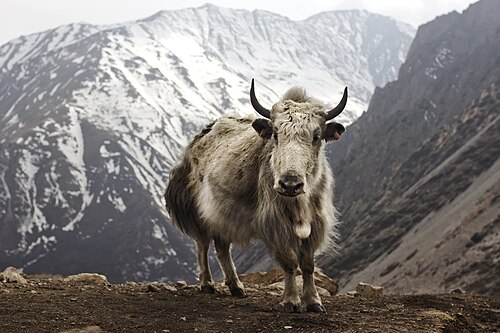
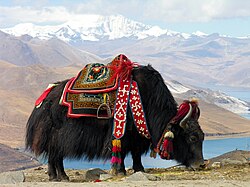
The yak is a large, shaggy-haired bovine built to survive some of the highest, coldest places on Earth. Wild yaks roam the Tibetan Plateau, while domestic yaks help mountain communities travel and farm.
Picture credit: travelwayoflife (CC BY-SA 2.0) · Dennis G. Jarvis (CC BY-SA 3.0) · Vyacheslav Argenberg (CC BY 4.0) · Wikimedia Commons
Where does the yak live?
Home: High plateaus and mountains of the Tibetan Plateau.
In the wild you find it in: China, India, Nepal.
Conservation status from the IUCN: vulnerable.
The short profile
Fully grown it measures up to 3.3 m long. It weighs about 800 kilograms. On the menu: plants.
The story behind it
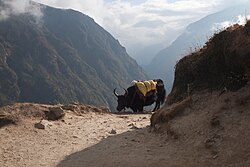
Yaks live comfortably at altitudes above 4,000 metres, where the air holds much less oxygen than at sea level, thanks to larger lungs and a heart nearly one-third bigger relative to body size than lowland cattle. Their extremely thick, shaggy coat, which nearly reaches the ground, traps warm air close to the skin and lets them survive temperatures as low as minus 40 degrees Celsius. For centuries, domesticated yaks have carried heavy loads across steep Himalayan trails and provided milk, meat, wool and even fuel from their dried dung to communities living far above the treeline. Wild yaks are now rare, hunted for meat and pushed out by grazing livestock, making the species vulnerable, while domestic yaks remain common across the high mountains of Asia.
Find it on the globe
Yak is there as a tiny animated figure that breathes and looks around. From far away the planet is only a blue ball; detail arrives as you zoom in, and this one appears once you are close enough. Open it on the globe.
It sits at its real coordinates, not near them — the same numbers listed in the facts above. Switch off the layer for this kind of place and it disappears again; the buttons for that are down the right-hand edge.
Questions children ask
How do yaks survive at such high altitudes?
Yaks have larger lungs and a bigger heart relative to their body size than lowland cattle, letting them absorb more oxygen from the thin mountain air. Their thick, shaggy coat also protects them from extreme cold at high altitude.
Are yaks wild or domestic animals?
Both exist: a small, endangered wild population still roams remote parts of the Tibetan Plateau, while millions of domesticated yaks live across the Himalayas, helping mountain communities with transport, milk and wool.
Why are wild yaks at risk?
Wild yaks have become rare mainly because of hunting for meat and competition with domestic livestock for limited high-altitude grazing land. Protected reserves in China now aim to help the remaining wild population recover.
Where these numbers come from
Every figure on this page was checked against public reference sources before publication. Where sources genuinely disagree, the text says so.
Last checked: