River · Canada
Mackenzie
The Mackenzie River is Canada's longest river, flowing through remote northern wilderness to the Arctic Ocean. It carries more water than any other river in the country.
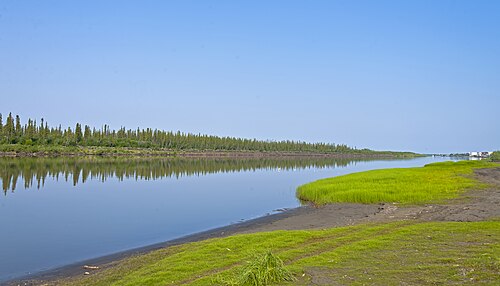
Picture credit: Daniel Case (CC BY-SA 3.0) · Daniel Case (CC BY-SA 3.0) · Crisco 1492 (CC BY-SA 4.0) · Wikimedia Commons
Where is Mackenzie?
The river begins at Thutade Lake, British Columbia, Canada.
It ends in the Beaufort Sea, Arctic Ocean.
Along the way it passes: Thutade Lake (source) → Williston Lake → Peace River, Alberta → Fort Chipewyan → Fort Smith, NWT → Fort Providence (Mackenzie begins) → Fort Simpson (Liard confluence) → Wrigley, NWT → Norman Wells, NWT → Fort Good Hope, NWT.
Countries on the river: Canada.
The story behind it
The Mackenzie River system begins as tiny mountain streams in British Columbia, which feed into the Peace and Slave rivers before flowing out of the enormous Great Slave Lake to form the Mackenzie proper. From there it winds north for well over a thousand kilometres through subarctic forest and tundra, past tiny communities that depend on it for travel, fishing and drinking water, since almost no roads reach this remote region. The river eventually spreads into a wide, marshy delta before emptying into the Beaufort Sea, part of the Arctic Ocean. Beluga whales gather near the river mouth in summer to feed and give birth in its slightly warmer waters. For much of the year the Mackenzie is frozen solid, and in winter people even build ice roads across it to reach isolated northern towns.
Questions children ask
How long is the Mackenzie River?
Counting its headwater rivers, the Mackenzie system is about 4,241 kilometres long, making it the longest river in Canada. It flows from British Columbia all the way to the Arctic Ocean.
Does the Mackenzie River freeze?
Yes, the Mackenzie freezes solid for much of the year because it flows through such a cold, northern region. Ice roads are sometimes built across it in winter to connect remote communities.
What animals live near the Mackenzie River?
Beluga whales gather near the Mackenzie's mouth in summer, while its waters and delta are also home to muskrat, moose and many kinds of migrating birds that nest there each year.
Where these numbers come from
Every figure on this page was checked against public reference sources before publication. Where sources genuinely disagree, the text says so.
Last checked: