Animal · Maldives, Mexico, Indonesia
Giant oceanic manta ray
Mobula birostris — the name this animal has in the language scientists everywhere share.
The giant oceanic manta ray is one of the largest fish in the ocean, with a wingspan that can stretch up to 7 metres across. It glides through warm tropical seas worldwide.
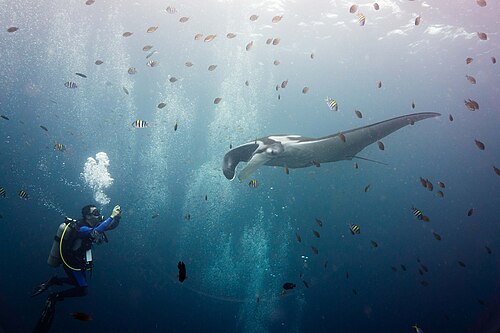
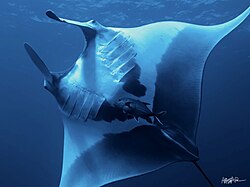
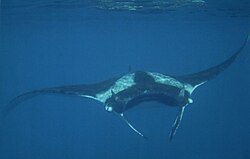
Picture credit: Daniel Sasse (CC BY-SA 4.0) · Alicia Christman (CC BY 4.0) · ecovore (CC BY 4.0) · Wikimedia Commons
Where does the giant oceanic manta ray live?
Home: Warm tropical and subtropical oceans, near reefs and open water.
In the wild you find it in: Maldives, Mexico, Indonesia, Ecuador, Mozambique.
Conservation status from the IUCN: endangered.
The short profile
Fully grown it measures Up to 7 m wide. It weighs about 1 400 kilograms. On the menu: tiny creatures it filters out of the water.
The story behind it
Manta rays feed by filtering plankton and tiny fish from the water, using strange lobe-shaped fins on their head to funnel food straight into their wide mouth as they swim. Despite their size, they are graceful swimmers, flying through the water with slow beats of their huge pectoral fins, and are known to leap completely out of the water, possibly to remove parasites or communicate. Manta rays visit cleaning stations on coral reefs, where small fish called cleaner wrasse pick parasites and dead skin off their bodies, a relationship that benefits both animals. They also have the largest brain-to-body ratio of any fish and can recognise themselves in a mirror, an unusual sign of intelligence. Manta rays reproduce very slowly, giving birth to just one pup every few years, which makes them especially vulnerable to fishing, and the species is now endangered.
Find it on the globe
Giant oceanic manta ray is there as a tiny animated figure that breathes and looks around. From far away the planet is only a blue ball; detail arrives as you zoom in, and this one appears once you are close enough. Open it on the globe.
It sits at its real coordinates, not near them — the same numbers listed in the facts above. Switch off the layer for this kind of place and it disappears again; the buttons for that are down the right-hand edge.
Questions children ask
Are manta rays dangerous?
No, manta rays are gentle filter feeders with no stinger and no interest in attacking people. Unlike stingrays, they have no venomous barb, and divers are often able to swim calmly alongside them at cleaning stations.
What do manta rays eat?
Manta rays filter-feed on plankton and small fish, using lobe-shaped fins near their mouth to funnel food in as they swim. A large manta may eat tens of kilograms of plankton in a single day.
Why are manta rays endangered?
Manta rays are endangered because they reproduce extremely slowly, usually having only one pup every few years, so populations cannot recover quickly from fishing pressure. They are also targeted for their gill plates, used in some traditional medicines.
Where these numbers come from
Every figure on this page was checked against public reference sources before publication. Where sources genuinely disagree, the text says so.
Last checked: